THE GOING RATE™ · THE TOOL

You already do the work. Now name the price.

Paste what you've done: the jobs, the volunteer roles, the years you ran the household like a small logistics company. We'll translate it into services you could offer, what they pay where you live and the words to ask for it.

Woman with long box braids working from home at a laptop in a warm editorial workspace.

You have a saved translation from earlier.

Messy is fine. Bullet points, paragraphs, brain-dump: the translator reads it all.

Being good at something isn't the same as wanting it. This decides what we build your pitch around.

Changes whether we talk in hourly rates or salary.

Only used to put your name on the report.

A few more things, if you want a sharper number

So nobody, including this tool, prices you under a number you already cleared.

If any. Leave it blank if that is not you.

Only used to price the household work at replacement cost. Skip it and we skip that section.

Nothing you paste is stored on our end. We keep the dollar figures as an anonymous running total, nothing more. Your last report stays in this browser, so you can come back to it, and "Start fresh" erases it. Estimates, not appraisals. But honest ones.
WHAT THE MARKET CALLS IT
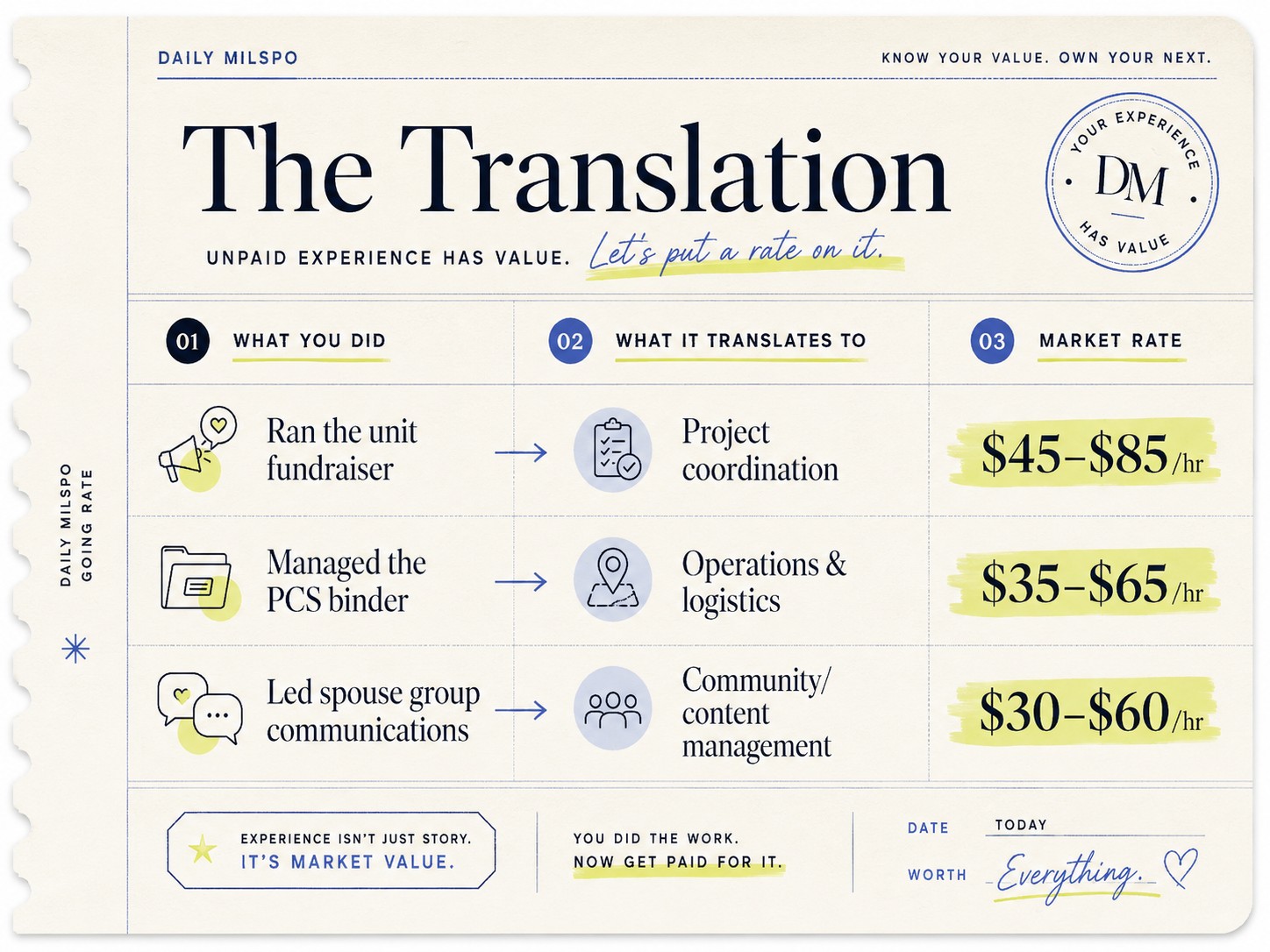
Branded rate card showing how unpaid or volunteer work translates into civilian skills and market value.

Running the numbers

Reading everything. Pricing what nobody priced before.

DAILY MILSPO THE GOING RATE

Personal Rate Report

You already do the work. This is what it's called, and what it pays.

Your translation

What you've done, renamed the way the market names it, with what it pays.

WHAT YOU DIDMARKET TITLEWHERE YOU LIVENATIONALLYPCS-PROOF?

YOUR FIRST OFFER: THE WORDS TO ASK

THE FULL ARSENAL · COMING TO THE OFFICE

Every role priced, the free-work invoice itemized and the exact words for the ask. Founding members get the complete version when the doors open.

RESERVE MY ROOM →

The part the number doesn't do

You're probably not going to say that number out loud tomorrow. Almost nobody does the first time. That isn't a discipline problem and it isn't a you problem.

One of us, after running this: "Now I need my big girl training to convince myself that I am this girl, and stop allowing myself to accept less."

That's the part a spreadsheet can't do. Believing a number takes repetition, not information. Something small and true every morning until it stops sounding like somebody else's number.

That's what the mornings are for. Two minutes, every weekday, free.

START THE TRAINING →

TWO QUESTIONS, IF YOU HAVE TEN SECONDS

Does that number feel high, low or about right?

Anonymous. No name, no email, nothing you pasted. Just the answer.

Want this where you can find it later?

The whole report, in your inbox, yours to keep. You'll get the weekday mornings too. Always free, unsubscribe anytime.

Sent. Check your inbox, give it a minute or two.

That didn't go through. Give it one more try, or come back in a minute.

"Save my report" opens your print dialog, then choose "Save as PDF". Reading this inside Facebook or Instagram? That browser cannot print, so use "Copy my report," or open this page in Safari or Chrome first.

Your dreams didn't PCS. They came with you.

DAILY MILSPO · YOUR TURN. EVERY MORNING. · DAILYMILSPO.CO

Estimates, not an appraisal or financial advice. Modeled from published pay and typical freelance ranges for the equivalent civilian role, adjusted for your market. Household figures are replacement cost, not income. Generated by The Going Rate™, Daily Milspo's own translation tool. Full method at dailymilspo.co/goingrate.

Every number here is an estimate: a starting point for a conversation, not a guarantee, an appraisal or financial advice. Your number moves with your niche, your proof and your nerve. All three are allowed to grow.

How we calculate this

What goes in. Only what you gave us: what you wrote in the box, where you live, the hours you said you can work, what you said you're after and any licenses or past pay you chose to add. Nothing else, and nothing from anywhere else.

How the rates are set. We identify the civilian role your work actually maps to, then estimate what that role typically pays, adjusted for your local market. These are modeled ranges built on published pay and typical freelance and consulting rates. They are not quotes from any employer, and they are not pulled from a live salary database.

How the household number works. That figure is replacement cost. It's an estimate of what it would cost to hire someone to do each of those jobs at market rates for the hours you do them. It isn't income, and it isn't money anybody owes you. It's a way to see the size of unpaid work that usually gets called "just helping."

What it isn't. Not an appraisal. Not an offer. Not a promise anyone will pay it. Two people with the same history can be worth different numbers in different towns, and the same person is worth different numbers on different days depending on who's hiring. Use this to start a conversation, not to make a decision on its own. We can't guarantee any figure is accurate for your situation, and what you do with it stays your call.

Who built it. Daily Milspo, in-house. The questions, the translation method and the pricing rules are ours. Your numbers are generated automatically each time you run it, following those rules. They are not looked up in a table and no person reviews them before you see them, so two similar histories can come back a little differently. That is why we call this a starting point rather than an answer.

If a number looks wrong to you, you're allowed to be right. Tell us using the two questions under your report.

BEFORE YOU GO

There's a reason this tool exists,
and it isn't the money.

Two minutes. Then you'll know what to call what you've been doing.

THE THESIS

The economy moved. We were already here.

There's a name for the way work happens now, and it isn't "the job market" anymore. It's a portfolio economy. Fewer people with one employer, one title and one straight line. More people holding several kinds of work at once, on purpose.

This is not a trend piece. It's the weather.

THE WEATHER

8.9MAmericans held more than one job in 2025, a record
1 in 3of the US workforce now does freelance or independent work
72%of employers say the conventional career ladder is outdated
41%of workers still want a straight, linear career. Fewer than half

Nobody had to sell us on any of this. We've been living in a portfolio economy since long before anyone named it, because the alternative was never on offer. One in four of us moves in a given year. The straight line was never actually available to take.

WHAT THE TRIP COST

1 in 4active-duty spouses move in any given year
32%lower earnings the year after a move. $31,222, against $45,793 for spouses who stayed put
29 weeksaverage job search after a PCS
28%working outside the field they trained for
$200klost across a 20-year enlisted career

Ninety percent of us say military service hurt our careers. We are not wrong.

We got here first and we paid full fare.

So by rights we should be the experts in this. Thirty years of practice at the exact thing the whole workforce is only now learning to do. That is not how it reads on a résumé, and it is not how it sounds when we describe it out loud.

So why does it still sound like a downgrade?

Because of the words. When one of us describes this work, here's the vocabulary on offer.

freelancer gigger side hustle contractor

Listen to what those actually carry. A gig is one night's work. A hustle is something you do on top of your real life. A freelancer is between things. Every one of them says temporary, interchangeable, small. Not one says career, and not one says it's building toward anything.

That language came out of rideshare apps. It was never built to describe a nursing degree, four moves, a program you ran for 300 families and eleven years of accumulated expertise.

And our own word isn't big enough either.

This community says "portable career." We have all said it. But listen to what it actually promises: that the thing you built might survive the trip. That's the whole offer. Survival.

It's a word about not losing ground. We deserve one about gaining it.

THE WORD IS

Carry-forward career

In accounting, a carry-forward is value you couldn't use in one period that moves into the next one instead of expiring. It doesn't vanish because the books closed. It waits, and it counts later.

That's the whole thing. Every move closes a period. The résumé gap, the "so why did you leave," the starting over: all of it treats what you built as though it expired at the state line. It didn't. It carried forward. Nobody ever let you book it.

The portfolio economy is where we work. A carry-forward career is what we're building in it.

THE HONEST PART

Better words do not fix it. The Syracuse researchers are right that spouses who go independent are usually adapting to a system that failed them, not chasing a dream. Licensing reciprocity, childcare and employers who actually hire us would do more than any reframe, and we'll keep writing about all three.

But policy takes years and you have a rate conversation this month. So price the carry-forward career while we wait.

Sources: D'Aniello Institute for Veterans and Military Families at Syracuse University; RAND; Bureau of Labor Statistics; Randstad, via SHRM.

Next week, another translation.

One thing we do for free, priced. Every weekday morning, in about two minutes.

Always free. Unsubscribe anytime. Nothing you pasted above goes with it.

You're in. The next translation lands in your inbox.

That didn't go through. Give it one more try, or come back in a minute.

THE COLUMN · INSTALLMENT No. 001

You've been calling it "helping."

Military life is full of work that rarely makes it onto a résumé. You ran the FRG. Organized the auction. Built the PCS spreadsheet everyone still asks for. Coordinated volunteers. Managed vendors. Raised money. Kept a household moving through three states while somebody else's career determined the ZIP code.

The market has names for those things. Project management. Operations. Event production. Community management. Logistics. Communications. Fundraising.

The Going Rate helps you see the translation.

This isn't an argument against volunteering. Communities run on it, and sometimes it is exactly where you want your energy. This is an argument for knowing the number, because you cannot decide what to give away until you know what it is worth.

So here's this week's translation, and a move to go with it: write one sentence in your notes app. "I produced [event] for [number] people on a $[number] budget." That's not bragging. That's inventory.

THIS WEEK'S TRANSLATION

Volunteer event coordination → Event production / project management

$45–$85/hr

In the civilian market. Yours is in the tool above.

You already do the work. Now name the price. The Going Rate runs weekly in Daily Milspo™.

Editorial desk still life with calculator, notebook, invoice, pen, and highlighted rate.

BEFORE YOU ROUND DOWN

Save the report. Bring it to the ask.

Numbers hold steadier than nerves. Run your translation, print the report and let the page do the talking when the rate question comes.

RUN MY TRANSLATION ↑